 |
AIA Design Awards October 2003 Fulton Station Fredrick H. Zal, NCARB Atelier Z |
|||
 |
 PORTLAND | |||
|
From the very conception of this project, our visionary client provided us with a number of clear directives: 1) Create a strong place that the community may appreciate; 2) Create a place where people enjoy living, working, shopping and dining; 3) Let’s make some money. After doing extensive research into the typology of mixed-use buildings in both Portland, Oregon and our larger global heritage, a synthesis of contextual materials were formally composed to inspire a strong pedestrian retail experience within a wonderfully rich neighborhood created from the pioneering spirit of early Portland.The pedestrian faces along the town’s “Main Street” and secondary shopping street will be augmented with retail storefronts that are have both a contemporary transparency, while still being referential to the “Wild-West” decorated shed architecture of this Village’s historic context. Making use of the 19’ slope along the longitudinal avenue, divisible office space and concise residential parking were slid in under the composite building mass to be a good neighborhood provider and to gracefully not become an ugly ‘elephant in the livingroom’. Urban living spaces above were inspired by the strong historic typology of live / work community along the eastern seaboard, and shall not foster the recent detrimental affects of anonymous snout housing. These mixed-income living spaces are a composite of ‘real artist’ loft rentals and for-sale townhomes. By securing partial funding through an environmental grant, the excavated earth shall be recycled into the primary Geo-Crete© shear wall, the parking slab shall dually function as a heat-sink for the commercial hvac aspects of the project, and portions of the zinc roof commercial gray-water collection system shall give way to an occupiable eco-roof for lounging in the southern sun. All spaces [even the storage bay] have an ample supply of light and natural ventilation for enjoyable passive cooling, which is coupled with radiant sprinkler-pipe heating and ambient gas fireplaces in the living units. To maximize construction efficiencies and minimize neighborly impacts, a pre-fabricated steel system shall be craned into place, and then twelve composite structural insulated panels [sip’s] affixed with their flat-lock zinc roofing shall be lifted off trucks and bolted to the structural system over a mere 48 hours. 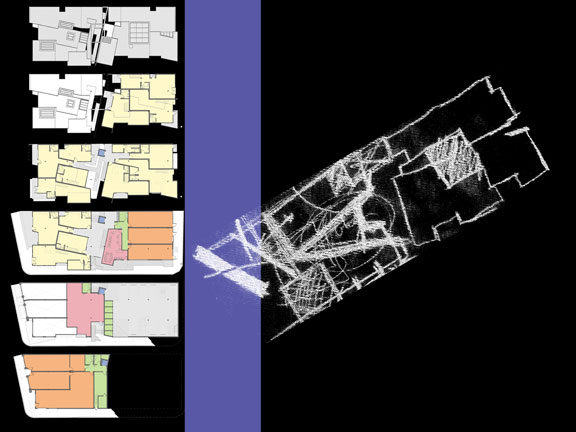 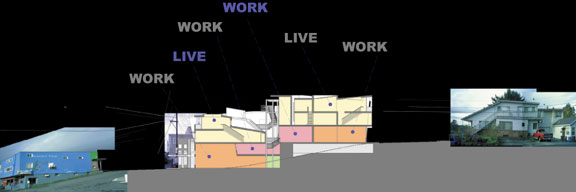 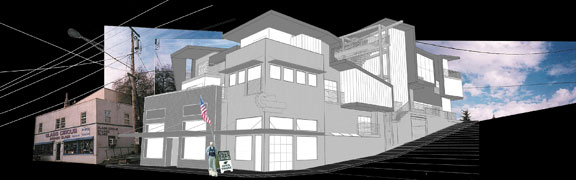 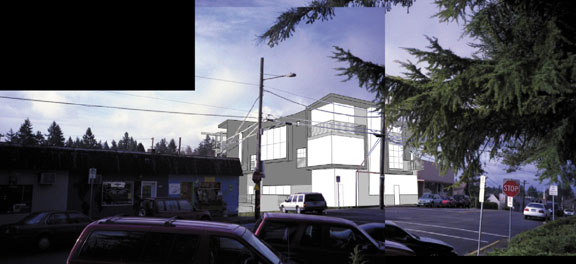 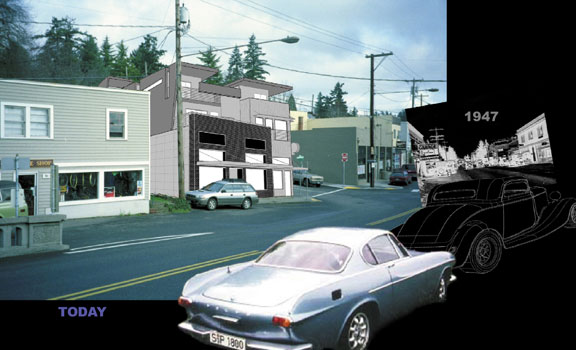 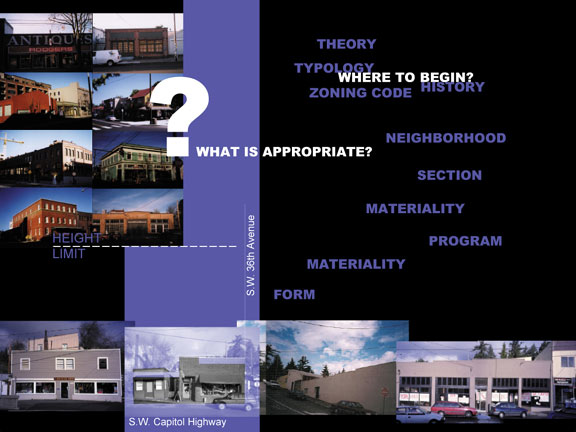
|
LAND|FORM an.Architecture theory of formal language History As we pull space from the void, and introduce it to the realm of Arcadia; we are empathically drawn to forms that heighten the tension between the two. Forms that explode, twist, shatter; forms that magnify our minimal transcendence from the chaotic wilderness in which we were born. At the crux of this geodesy is the evolution of context into juxtapositions of land and form in space. As such, it is important to understand the underlying principles that create this context, and then learn methods for its manipulation into derivative physical symbiotes. This is applicable in any context; rural or urban, but for the purposes of simplicity, we shall only discuss it in terms of pure landscape. Contemporary 'Land|Form' work can be traced back to the studies of Michael Heizer and his anarchitectural brethren. Through his investigation of earthworks, he began to uncover the crystalline forms pioneered by J. Struver [1888]. (INSERT "Figure 1.1: Crystallography [J. Struver, 1888.]" HERE.) The basic premise is that forms are composed of complex inter-relationships of non-planer polyhedral surfaces, as opposed to blob-like hyperbola. The "Chaotic Geometrics" [1987], which Heizer created, synthesized these studies of 'natural' form through a series of compounded anti-prismatic emulations in readily available materials. As such, our methodology assumes that this system is appropriate for further investigation and synthesis into habitable forms beyond just scale prototypes. Such assumptions are validated by the similar methodology used in the theoretical and physical constructs of Lebbeus Wood's "New City Solotower" [1987], Coop Himmelb[l]au's UFA Cinema Center [1993-1998], Antoine Predock's Spencer Theater for the Performing Arts [1994-1998], and Daniel Libeskind's Victoria and Albert Museum Extension [1996-], with the addition of empathic and material qualities. Figure 1.1: Crystallography [J. Struver, 1888.] Skin To begin this discussion, you must imagine a line that mediates between the Earth and the Sky. As this is a dimensional situation, the line transforms into a zero-plane, a skin of no thickness that is draped between the undulations of the Earth/Sky, stretching out beyond the quantification of our perceived horizon. It is quintessential to our discussion, that anything which we create is merely seen as a modification of this relationship, and not a purely creative act; similar to the geotectonic forces that from time to time shall swell up and spew stone up towards the heavens; leaving chasms into its belly. We do not create space, we only transform relationships between matter and air for the purposes of our emotive intents. Figure 2.1: Shinkenchiku [Atelier Z, 2002.] Zero-Space To assist in comprehending this phenomenon, imagine the Earth/Sky skin as a sheet of paper… Holding it between one's hands, one knows that it has two sides; but still thought to have zero thickness. It is a three-dimensional form, mitigated to the dishonor of a mere two-dimensional comprehension. What if the skin actually did have zero thickness? What if the sheet of paper became so thin that it was only one-sided; shedding its ineffectual dimensionality? We propose that a planar element could not only achieve such a negligible breadth, but that we could make use of its new lack of dimensionality. At the very moment prior to its second side's ghostly dissolution into nothingness, by slicing between the space-time continuum; we can pull the two sides of the sheet apart… As the two one-sided planes expand across known space, the void contained within unfolds into consciousness. Just as when virtual NuRBs upon the Earth's surface rise up, it begins to create a vacuous surface against the inert tensions of the land mass. The exterior skin that is formed has recognizable dimension, a quantifiable objectivity, a method to which we have become prescribed and normalized; yet there is also an interiority, which defies the current realms of spatial occupation and quantification… It is this zero-space, this spatial realm without edge or boundary, the space within and without, the space of shadows, the space of negation within which we shall pursue the pedagogy of our works. Figure 3.1: duPont / Corian Pavilion[Atelier Z, 1999.] Empathic Morphology At this point the skins are still in the fluid sketch state of the mind, akin to the intricacies of amorphous polymers in Roxy Paine's "Blob Case #11" [1998]. The embryonic plasma may be pushed, pulled and nullified to gain form. By applying forces upon the surface of the zero-space skins and folding them into new forms that are derivative of the empathic and phenomenological needs of space; we begin to form the artifice, which we call architecture. The mind's perceptions carve apertures to the Earth/Sky beyond from both within and without. The hand reaches out into the plasma and creates surface and objects for habitation of this new space. As the body moves through this evolving space, juxtapositions of anti-prisms and shards are instigated that provide cadence for walking and climbing. The geomorphic terrain of the zero-space folds around the body and thicken as required to create a place to sit, lie, and stand. It is a holistic space still visceral and exciting; full of the kinematics of pure Euclidian form. Material Crystallization As the applied forces continue to evolve, the skin itself becomes not just a mediator of Earth/Sky, but actual form, distinct from its previous non-dimensional relation. As with Eric Chesebro's "Successive Randomization of the Cubic Torus" series [1997/1998], the needs of habitation harden the thickened skins into a physical reality to be constructed from ready materials, which we have hewn. The mediator is neither Earth nor Sky, neither solid nor void; it is the zero-space. The empathic and phenomenological qualities, which derived the forms, call out for specific material properties. Differentiation between opacity and translucence, the sound of hard against soft, tactility of smooth in relation to rough; these are the properties which allow us to define material form and the detailing of their intersections. Figure 4.1: Fulton Station[Atelier Z, 2002.] Figure 5.1: Armadillo Zen[Atelier Z, 2002.] Praxis We are continuing to pursue this branch of exploration, which evokes the desired visceral emotive response to space in our current works through the evolution of simple spatial skins as mediators between earth and sky. FIGURES: Figure 1.1: Crystallography [J. Struver, 1888.] This image was referenced by Albert Elsen, Stanford University, 1990, in discussion of Bruce Beasley’s bronze sculptures in relation of formal logic, cubism and the emulation of biological kinematic form through polyhedra. Figure 2.1: Shinkenchiku [Atelier Z, 2002.] Exploring the realm in which muses may be served / spared emptiness, this theoretical construct was formulated for a design competition. Figure 3.1: duPont / Corian Pavilion [Atelier Z, 1999.] The pedagogy discussed in this article became clear during our design of an exhibition pavilion for duPont/Corian. The task was to create a simple form, which was derived from a sheet. During our exploration, we came to classify two particular methods of morphing this skin: Drape and Fold. As a synthetic material, Corian may be heat formed into undulating hyperbolics reminiscent of cyber-blobs. The second pathway of folded forms, forced upon us more rigor and a level of mathematical intrigue, which was have been pursuing further. Using our current construction practices, it seems most appropriate to explore the node / plane manner of this system. Plus, as a recognizable inorganic configuration, such forms embrace the imperfections of our humanity as a counter pose to natural plasticity. Figure 4.1: Fulton Station [Atelier Z, 2002.] This is a mixed-use project designed for the Multnomah Village area of Portland, Oregon. Its complex program is shrouded in a simple folded skin system of roofs and armature. Figure 5.1: Armadillo Zen [Atelier Z, 2002.] This prototype house was designed for Fredrick H. Zal, and shall be built in Portland, Oregon using prefabrication. The project was also published as part of the Seattle case Study Homes [ScSH] design competition in conjunction with Peter Miller Books. | |||
|
REFERENCES: Beasley, Bruce. “Bronze Sculpture”. 1990, Pepperdine University, Malibu, California, USA. Celant, Germano. “Michael Heizer”. 1997, ISBN: 88-87029-02-4. Chesebro, Eric. “Successive Randomization of the Cubic Torus” series, 1997/1998, Augen Gallery, Portland, Oregon, USA. Heizer, Michael. “Chaotic Geometrics”, 1987, Tony Safrazi Gallery, New York City, New York, USA. Holden, Alan. “Shapes, Space, and Symmetry”. 1971, ISBN: 0-231-03549-7. Lynn, Greg. “Intricacy: Art, Architecture and New Media”. 2003, Institute of Contemporary Art, Philadelphia, Pennsylvania, USA. Libeskind, Daniel. “The Space of Encounter”. 2000, ISBN: 0-7893-0492-9. Paine, Roxy. “Blob Case #11”, 1998, James Cohan Gallery, New York City, New York, USA. Werner, Frank. “Covering + Exposing: the Architecture of Coop Himmelb[l]au”. 2000, ISBN: 3-7643-6079-8. Woods, Lebbeus. “The New City”. 1992, ISBN: 0-671-78117-0. Woods, Lebbeus. “Earthquake!”. 2001, ISBN: 3-211-83643-8. Zimmermann, Elizabeth + Collins, Brad. "Antoine Predock, Architect 2". 1999, ISBN: 0-847-82138-2. |
LINKS: 971019: Fulton Station |
|||
