|

|
|
|
|
Material Worth: Architect Fredrick Zal draws inspiration from building materials and their history
Thursday, 08 March 2007 BRIDGET A. OTTO |
|||
|
Otto, Bridget A. The Oregonian: “Material Worth: Architect Fredrick Zal draws inspiration from building materials and their history”, 08 March 2007, Homes + Gardens, p.6-9. http://www.oregonlive.com/hg/oregonian/index.ssf?/base/homes_gardens/117320911489810.xml&coll=7 |
|||
|
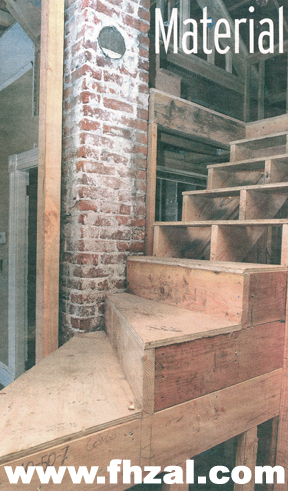
Joanna Tompkin's quaint Victorian house sits on a quiet corner in Goose Hollow. The home's mere 900 square feet and side garden chock-full of bulbs and flowering trees found a place in Tompkin's heart last summer. But there were issues. How, she wondered, could she make use of the unfinished attic? More important, how would she get to the attic? Enter Eric Eaton, a master carpenter and general contractor, who directed her to architect Fredrick Zal. Zal, true to his protocol, talked with Tompkin about materials, in particular the no-longer-used brick chimney that ran from the kitchen up through the center of the attic. "It was beautiful old brick, over 100 years old," Tompkin says. She loved it, too, and that cemented her relationship with Zal, who puts as much importance on materials as he does on design. The integration of the old chimney with the new staircase is an example of how Zal likes to work. While others might have removed the chimney -- just as Tompkin's neighbor had -- Zal used it to gain access to the attic. Almost as important, he used it because the brick was part of the home's story. To touch it is to be transported back to when the house was built and the chimney vented the wood-burning stove in the kitchen. |
|

Fredrick Zal used the old chimney in Joanna Tompkin's 1895 Victorian as the spine to design the new staircase around. The combination of old and new adds a chapter to the narrative of the home. |
|
|
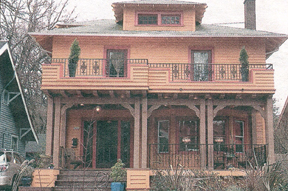
The marriage of the new staircase to the old bricks speaks to what Zal calls the material narrative -- how materials bring stories to design. Material narrative is something the Portland architect and owner of Atelier Z has considered for some time. The process started when he thought about how things come together, how we end up with our belongings, and how they relate to our past, our family and our history. Through this, he came to understand the important role materials play in design. "There's a sense that these objects have already had a life. That's what material narrative is about. It's not so much putting a narrative into something, it's embracing the narrative that's already there. . . . If it's a beam, you think about the barn or the house that it came from, that it had been a part of, and you can imagine the cows that were tied up to it." Zal, who writes extensively on the theory, practice and materials involved in architecture, sculpture and everyday life, is not suggesting reusing materials for the sake of recycling. Rather, he suggests reusing materials because the narrative makes sense once again in the new application. He asks many of his clients to answer a fairly lengthy questionnaire that covers topics from sound to touch to movement to scale. He's not after deep thoughts; rather, gut reactions that provide an insight into how his clients use space and materials and where their priorities lie. In explaining his philosophy, Zal pulls out the schematics for a project he's designing for Portland's HiiH Gallery, the makers of handmade paper lamps and light sculptures. "When you look at it," he says of the drawing, "basically, it's a box. As weird and funky as it might look at first, in reality it's a box." That's what most retail space is, he continues, but then he wonders aloud: "How do you make a box more than a box? "In this case, it comes down to the materials used." Zal explains that the upper level of the project will be a yoga studio. Garage-style doors will open at this level, which requires that railings be installed. Those railings will be designed to resemble classic wooden ballet barres. They will be warm to the touch and reminiscent of dance studios of the past. As an artist and performer -- he was recently cast as a vampire victim in a pilot for a yet-to-be-named television show -- Zal understands interpretation. With material narrative, he says, it's about how we want to interpret the past for the future. "You as the user bring things into your life to help you live your story. . . . When you bring materials in, you're helping yourself create the story you want the world to see." A change of materials brought Nick Sherman and Treva Dea-Sherman's 1910 home in Laurelhurst back to its original glory. They had a photo from 1911 that showed a widow's walk off a second-floor bedroom. They loved that look and the story it told, but they wanted something grander in scale that would also replace the concrete front stoop that had been added at some point. Sherman says the choice of materials was crucial in connecting the new veranda to the old home, and Zal and Eaton -- who also worked on this project -- knew that. "There's nothing that would be a disconnect," Sherman says of the addition. "I've been on the porch and people have walked by and clapped." [link to project] Zal truly believes that if you take the time to surround yourself with the things you love, you'll be happy. "It's really just that simple," he says. |
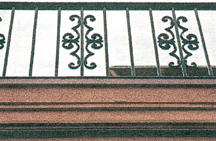
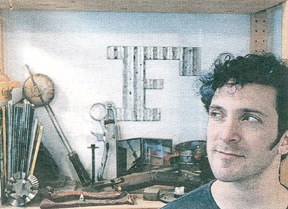 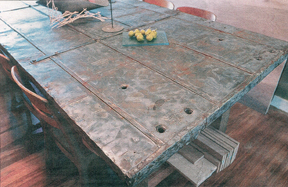 In his own home, Zal has incorporated materials that make a visitor ask: What's the story behind this table? How did you come up with that design for the railing? 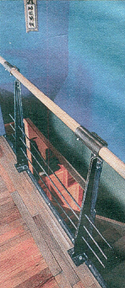 [link to project]
  [link
to project]
[link
to project]
Zal and master carpenter Eric Eaton knew materials would be as crucial as design when it came to creating a veranda for Nick Sherman and Treva Dea-Sherman's home in Northeast Portland. |
||