|
|
|
|
Back in Time: Period restorations strike balance between amenities, authenticity
Sunday, 09 September 2007 JOHN KIRKLAND |
Portland freelance writer John Kirkland can be reached at kirklandjohnr@msn.com
|
|
|
Kirkland, John. The Oregonian: “Back in Time: Period restorations strike balance between amenities, authenticity”, 09 September 2007, Homes + Rentals, p.H1-H2. |
||
|
A century ago, Sears Roebuck & Co., Montgomery Ward and several other companies did a booming business selling mail-order kit homes. The homebuyer would pick a style out of a catalog, and the home would be shipped by rail in pieces: everything from windows and doors to staircases and shingles. You also could purchase plans and buy the materials locally -- an option that made economic sense in the timber-rich Northwest. Joanna Tompkin believes her 1895 Victorian at 1730 S.W. Clay St. in Portland's Goose Hollow neighborhood originated from a Montgomery Ward catalog, and that other houses on the block were probably mail-order homes as well. It's a point of historical interest and a great conversation starter, but when she bought the home a year ago, it wasn't enough to give it the kind of value she wanted. It needed restoring to strip away 112 years of aging and bring the home back to its original charm. Over the next 12 months, Tompkin did just that, and in the process added 650 square feet of living space. |
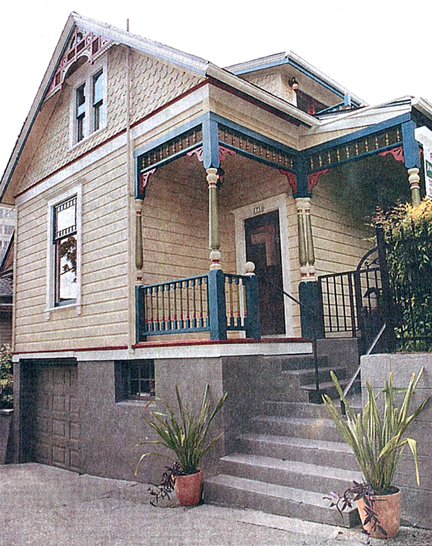
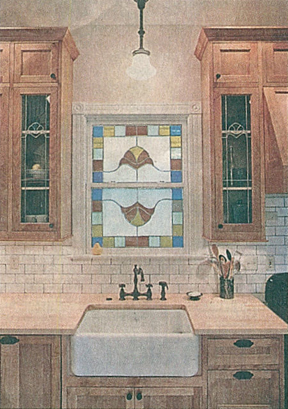
Owner Joanna Tompkin renovated her 1895 Victorian in Goose Hollow in keeping with its era, redoing the kitchen with period-appropriate materials such as butcher block counters, alder cabinets and a pendant light fixture. |
|
|
Period restoration is a tricky business that pits historical purity against modern practicality. If designed strictly for purity, the project uses only the materials, colors, styles and architectural layouts of the original. Taken to the extreme, a 100-year-old home redone for historical accuracy down to the last detail wouldn't even have electricity. A happy medium for most restorations is to shoot for the spirit, not the letter, of the period. In Tompkin's case, this meant tastefully straying from the standard, compartmentalized Victorian floor plan and opening it up to make the home more welcoming. She removed a wall that separated the kitchen from the living room and built a staircase that wraps around the kitchen's original brick chimney. The staircase leads to a new sitting area and a master suite in what previously was an attic. |
||
|
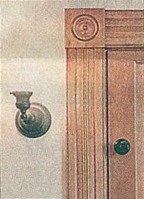
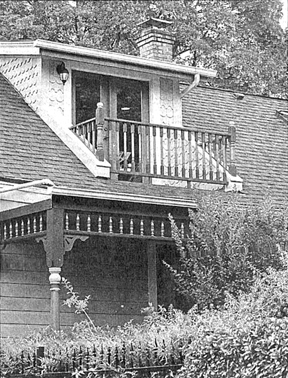
Livable authenticity She also brought back some older touches, giving some spaces -- the kitchen in particular -- a more period look than what had been there before. When Tompkin bought the three-bedroom, two-bath home, the kitchen had Formica countertops and multiple layers of vinyl on the floor. The crew from the contractor she hired, Eaton Construction, ripped out the vinyl and replaced it with white hexagonal tile. They also swapped the laminate countertops with butcher block, and replaced the particle board cabinets with natural stained alder cabinets. Tompkin chose an Aga stove that has an almost woodstove-like appearance. It's the only appliance evident at first glance; the refrigerator and dishwasher have alder paneled fronts to make them blend with the cabinetry. "I did my very best to make it look authentic, but not so authentic that it looks like a museum," she said. Tompkin and Eaton Construction salvaged what they could, then filled in with new materials where needed. Much of the woodwork is refinished original, and the team managed to save a stained glass window that had been in the house since it was built. The new materials fit right in with the old, including a duplicate window made for the kitchen, crafted gingerbread shingles for the exterior and hand-turned bullseye doorframe corners. Tompkin also selected Rejuvenation fixtures and oil-rubbed bronze pulls for the cabinets. But the biggest part of the job was structural and largely unseen. In order to convert the attic, the builders had to start in the basement and work their way up, adding more wood to enable the house to handle the added load and also to upgrade it to current seismic standards. By the time they were done, the amount of structural wood in the house had doubled.
|
|
|