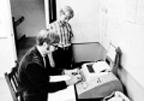
Bill
Gates and Paul Allen
The History Of Microsoft
Microsoft was formed by Bill Gates, whom was born William Henry Gates III on October 28,
1955 to a family that was successful in business, living a comfortable upper middle class life in Seattle, Washington.
Early in his elementary school days, Bill Gates quickly shot to the head of the class, consistently outscoring his peers in most subjects, but especially math and science. His parents soon enrolled him in Lakeside Prep School, where the atmosphere was intellectual enough to stimulate the young Gates. This move to Lakeside would prove historic, for it was here, in the spring of 1968, that he was introduced to computers.
At that time, computers were still too large and expensive for the school to purchase one of its own. Over the next ten months or so, the school struck agreements with various corporations who allowed the students to use their computers. Bill Gates, his buddy Paul Allen and a handful of others quickly took to computing. In fact, they began to skip classes, opting instead to stay in the computer room and write programs, read computer books and find out exactly how these machines worked. They soon learned to hack the system, and altered and crashed valuable files until they were banned from the computer. Soon, however, Bill and his friends were actually hired by the computer company to find bugs and explore weaknesses in the system, which kept causing the computers to crash. Instead of paying the boys for their time, they were granted something even better--unlimited computer time.
Gates has been quoted as saying that that was the time when he got into computers fulltime. "I mean, then I became hardcore. It was day and night," he said. The boys used their time eating, drinking and breathing computers. They studied manuals, explored the system, and hounded the employees with questions until they had formed a base of knowledge that would eventually lead to the formation of Microsoft.
The computer company that was hiring the group went out of business in 1970, and the boys had to find alternate sources for computer time. They were soon hired by Information Sciences Inc. to write a program for payroll. This time they actually earned money as well as enjoying the unlimited computer time. It was during this time that the group gained notoriety for their skill in computer programming. They were hired or contracted by various organizations to find bugs and fix them. Each job helped Gates and his friends learn their skill and delve ever deeper into the world of programming.
In the fall of 1973, Gates left for Harvard University. He enrolled as a prelaw student, but spent most of his time in the campus computer center, programming away. He stayed in touch with Paul Allen and they continued to talk about future projects and the possibility of one day having their very own business. Allen even moved to Boston to be closer to Gates, so they could continue working on projects. Allen continually urged Gates to quit school and work with him full-time, and Gates was unsure of what he wanted to do. This was soon to change.
One year later, Paul Allen saw the first microcomputer on the cover of a magazine. He bought the magazine and went immediately to show it to Gates. They realized the time was right. The home PC business was about to explode and someone would need to provide software for the machines. By stretching the truth somewhat, Gates arranged for a meeting with the Altair manufacturers. He had called them to let them know he had a program written for them. After the appointment was made, Gates and Allen stayed up for nights, feverishly writing the program he had promised. It worked perfectly at the meeting, and everyone was impressed. They sold the program, and saw that this was something they could do for real. Within a year, Gates had dropped out of Harvard and Microsoft was formed.
The company went through some rough first years, but eventually were able to license MS-DOS to IBM. The IBM PC took the public by storm, and its success signaled the success of Microsoft. Microsoft continued writing software, for businesses as well as the consumer market. In 1986, the company went public, and Gates became a 31-year old billionaire. The next year, the first version of Windows was introduced, and by 1993 a million copies per month were being sold.
In 1995, Gates knew that the Internet was the next area of focus, and the course of Microsoft shifted dramatically. The popular Internet Explorer browser soon became a bestseller. Today, Microsoft software is everywhere.
'Words of Truth'
Bill Gates gave a speech at Mt. Whitney High School in Vasalia, California about 11 things they did not and will not learn in school. He talks about how feel-good, politically correct teachings created a generation of kids with no concept of reality and how this concept set them up for failure in the real world. He was paraphrasing a passage from Sykes, Charles J. "Dumbing Down Our Kids: Why American Children Feel Good About Themselves, But Can't Read, Write, or Add" [St. Martin's Griffin Press, 1996; ISBN: 0312148232].
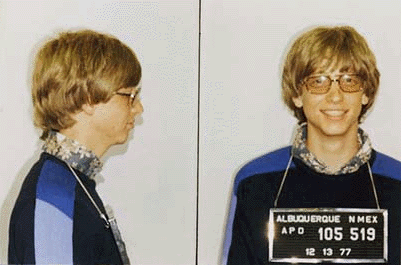
The media watchdog magazine " Brill's Content", published on Monday, August 17, 1998 , features the photo of a long-haired, smiling, 21-year-old Gates as part of a story called Making Bill, on the computer giant's public relations methods. The mugshot was provided, on request, by the Albuquerque police department in New Mexico, although officers there could not remember the reason for the arrest.
Microsoft was based in Albuquerque in its early days and its move to Redmond, Washington has, in the past, been attributed to Gates' problems with his New Mexico drivers' licence after numerous traffic violations. He is said to have been given three speeding tickets on his original drive to the new headquarters in the Pacific Northwest.
The Microsoft chairman had a Porsche 911 and used to race in the desert. The company's co-founder Paul Allen once had to bail him out of jail. The 911 was quickly followed by a 930 Turbo, a Mercedes, a Jaguar XJ6, a Carrera Cabriolet 964, a Porsche 959 and a Ferrari 348, which he spun in the sand and was labelled the "dune buggy". His home on Lake Washington has a 30-car garage.
Rule 12:
If you can read this - Thank a teacher!